Troubles with adaptation
This page contains demos from the paper Everything, everywhere, all at once? The when and where of repulsive adaptation effects in mind and brain, co-authored with Sam Clarke.
You can find more demonstrations for, e.g., number adaptation specifically, on our number adaptation demos page.Demo #0: Color adaptation, for comparison
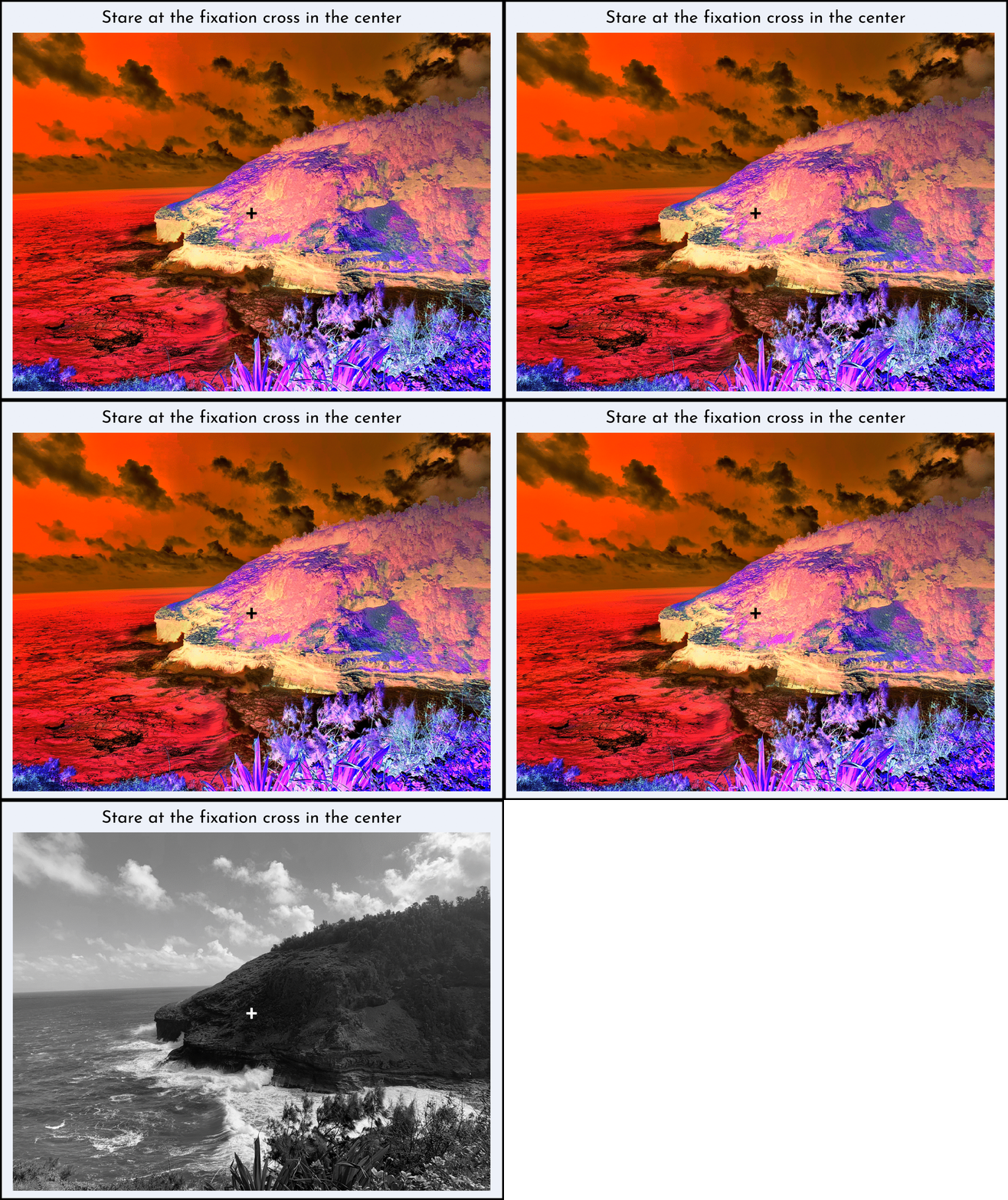
This is a canonical demonstration of color adaptation. After you stare at the colorful image, you subsequently perceive color in a colorless image. As you can see if you move your eyes, the second image that you see has no color at all. The color that you see is caused by a repulsive aftereffect — adaptation.
Demo #1: Canonical Number Adaptation
This is a canonical demonstration of number adaptation. Putatively, because you adapted to a large number on the right side, you experienced a repulsive aftereffect on number causing you to perceive few items in the test display. The original demonstration from Burr & Ross (2008) can be seen here.
Demo #2: ‘Reverse’ number adaptation
The traditional number adaptation view predicts bi-directional effects: Large numbers should make middling numbers look smaller and small numbers should make middling numbers look larger. However, there is no clear effect of adaptation when adapting to only a small number.
Demo #3: Cross-modal adaptation
In these trials, the observer would be tasked with estimating the number of tones that they heard. Unlike other kinds of adaptation, cross-modal adaptation cannot be experienced as a demo. This is because there is no direct comparison in the display. The purpose of this demonstration is just to convey what trials in this experiment are like. Notice: As an observer, you can easily count the relevant stimuli.
Demo #4: Retinotopy
Some work on number adaptation (see Anobile et al., 2014; DeSimone et al., 2020) controls for certain features (e.g., area, density) by manipulating the spatial envelope in which dots appear. The assumption is that because number adaptation is spatiotopic, this is acceptable. What this demonstration shows is that retinotopy matters: Dots selectively disappear from awareness in the places where you adapt to other dots. In other words: This is just another example of mistaken assumptions about how number adaptation works.