Representing Time
Making sense of time, moment to moment
Our lab’s interest in the nature of space naturally leads us to investigate the nature of time. Interestingly, though, while the cognitive and neural bases of spatial representation have been thoroughly investigated, the basic building blocks of temporal representation are relatively poorly understood. Our lab, in collaboration with momentslab.org, is interested in characterizing the ‘units’ of perceived time — not only at the scale of seconds, as most work has investigated, but also at the scale of days, weeks, months, and years.

Experiences across time
The guiding principle in our work is that while time unfolds continuously, our experience of time — and our mental representation of it after the fact — comes in the form of discrete events. From the ‘blooming, buzzing confusion’ of continuous experience arises a sense of discrete moments, events and periods that shape our sense of the passage of time.
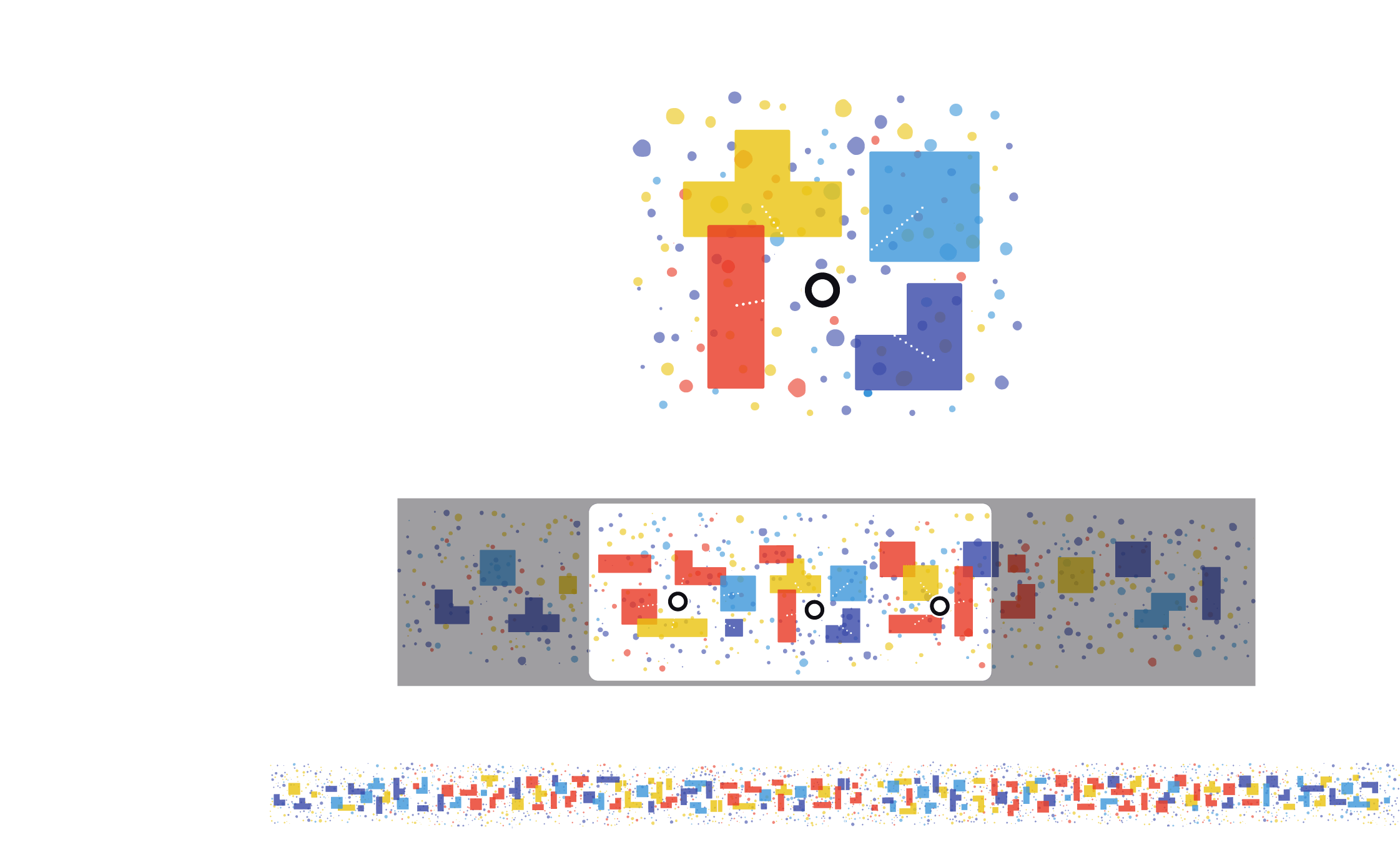
Specific moments (i.e., taking an exam) combine to create larger events (i.e. the end of a semester), which are part of broader periods of time (i.e., first year of college). These discrete units push and pull at our sense of time. For example, we know that moments within a given period tend to be perceived as closer in time than equivalent moments that span multiple, distinct periods. And we know that repeated events can seem simultaneously closer (if asked, e.g., when it last occurred) or further away (if asked, e.g., when it first occurred). This is one of the ways that the representation of time and the representation of space are deeply intertwined: Both are shaped by discrete mental structures that are superimposed over continuous experience.
Explore our other research branches…
View All Publications